
Thornlea EcoTeam
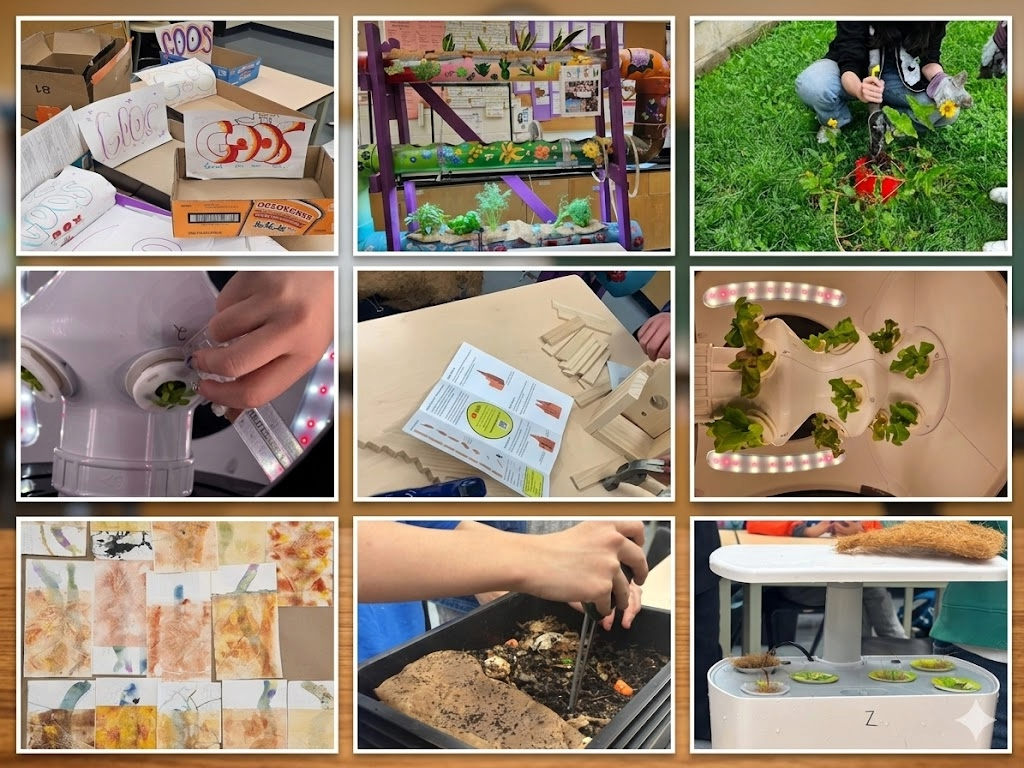
Environmental sustainability is a way of life at Thornlea Secondary School, where students are leading meaningful action for a more sustainable future. Thornlea students can engage in a variety of different activities. For example, students who support the Butterflyway Pollinator Garden volunteer to help maintain the garden in the summer and take plants home during the winter to care for them. The team, known as The EcoTeam Council, also shares presentations at staff meetings focused on sustainability. There are opportunities for staff members to support as well, such as requesting and using “Good on One Side” (GOOS) paper boxes.
In December of 2024, Thornlea became a Sustainable Future School. Then, in May 2025, after an extensive audit by Ecoschools Canada, Thornlea earned a Platinum EcoSchools certification, recognizing the school’s exceptional commitment to environmental responsibility.
Students led the decision to apply for EcoSchools platinum status, said Staff Lead Cindy Wan. “The EcoTeam Council started as an environmental club to increase students’ sense of belonging, learn about environmental issues, and raise awareness about global concerns,” said Wan. “Student leadership led to the ambitious endeavour of going on the journey of being an EcoSchool. Using Science, Technology, Engineering, Art, and Mathematics, we have fostered a community of students, staff, parents/guardians and partners who mentor and learn from each other and take action to help save the world.”
Students at the school are actively involved in a wide range of hands-on projects, including conducting waste audits, building bird sanctuaries, and supporting hydroponic vertical farming. Students learned that this hydroponic method – featuring stacked rows of plants – uses 90-95 per cent less water and 98 per cent less land than traditional farming (Behm, 2026). Regarding this farming method, Grade 12 student Carmen said, “In EcoTeam, we get hands-on learning opportunities with hydroponic and vertical farming systems and how they contribute to the United Nations’ sustainable development goals. Our team is very supportive, and I found that it allowed everyone to get to know each other across grades and interests.”
Experiential learning is central to the school’s approach. Students engaged in Indigenous place-based learning and participated in a Climate Action Forum. In their work, students have learned to incorporate a variety of skills and knowledge. For example, students combine coding for moisture detection with Indigenous plant knowledge. Art, Science, and Indigenous place-based learning opportunities have culminated in the creation of a mural that will be displayed in the Science wing at Thornlea. The mural incorporates natural materials and haiku poetry to represent Thornlea’s commitment to sustainability now and in the future. Thus, the work of Thornlea’s EcoTeam moves beyond STEM to STEAM (Science, Technology, Engineering, Art, and Math).
The school is currently hosting over 30 active projects that focus on academic research, community wellness, and sustainable living. These projects are led through the EcoSchools initiative and include more than 50 people. Grade 10 student, Maya, said, “Since last year, the number of kids on EcoTeam has more than doubled. This club has given me so many opportunities.” Student Irene in grade 10 explained that these opportunities range from “learning about hydroponics, waste management, coding, competitions, as well as meeting many great people and developing new skills including leadership and communication.” This range of learning opportunities is helping students develop transferable skills for the future.
The school’s infrastructure also reflects its commitment to sustainability. The Council has used the school’s original 1968 structure to create a thriving indoor ecosystem. Highlights include engineering light for a controlled environment and allowing students to bring the cognitive, wellness, and air purification benefits of nature indoors.
To support this work, the school applied for grants, including the Young Reporters for the Environment Grant and the Jane Goodall Roots and Shoots Grant.
“EcoTeam has helped me learn more about how we as individuals can help and care for our environment, like using reusable water bottles instead of plastic ones,” said EcoTeam Member and Grade 9 student Gemma. “It has deepened my interest in learning more about how we can help the environment, and it gave me a lot of opportunities to put myself out there and meet new people. It keeps me curious about how we can further improve the quality of our environment and how we can continue to help it.”
Grade 9 student, Benya, revealed EcoTeam Council’s core objectives well when she said, “Being part of Thornlea’s EcoTeam has shown me how small actions can create real change. We work together to make our school more sustainable and inspire others to do the same.”
Behm, S. 2026. Vertical farming is growing up. Farm Credit Canada. Retrieved April 17, 2026 from
https://www.fcc-fac.ca/en/knowledge/vertical-farming-is-growing-up.